|
|
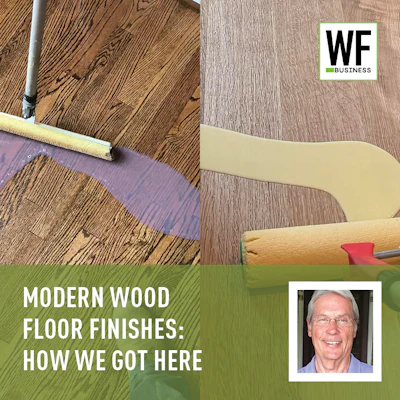
Sometimes it helps to add a little history to how we got to where we are today. Where we are today is that the wood flooring industry has the biggest and best selection of finishing products we’ve ever seen. The available products offer us more options for providing furniture-grade wood floors than anyone could have imagined. They can do it safer, cleaner, quicker and with longer lasting results than old-timers like myself could have ever imagined. And that’s a very good thing—but it raises other challenges, and that’s where the history comes in handy.
My dad went into the wood floor business in 1946, endured the crushing wood floor depression of the ’60s and survived because he listened to that all-important topic of what homeowners did not want: They did not want nor would they live with waxed floors. That meant some type of surface coating was going down, and the new kid on the block was oil-modified urethane. It was tougher, more durable and resistant to common household chemicals—and it was pretty much the only option available. For the most part, it did the job very well, but it also unveiled a new challenge: Could homeowners learn to live with a coating instead of sealers and waxes? And in one form or another, that has been our biggest challenge ever since.
Redefining finish objectives
The surface coating was the new battleline—the point of contact with shoes, furniture, pets, appliances, food, cleaning products, beverages and anything else coming through the door. It’s where you will see the damage first. So, when critics started complaining that urethanes scratched and developed wear patterns, we didn’t see it as a failure of the finish. If the coating is on the floor to protect the wood, who is going to protect the coating?
What we saw was a lack of understanding on the part of the homeowner to provide basic protection for the finish. To that end, when I’m looking at a project, I start collecting information: How large is the family? Are there pets? Do they entertain? Do they have a cleaning service? … and all the other variables. The more I know about their lifestyle and habits, the more I can help them make informed decisions about the best finish type for them.
The ’80s: A transformative decade
The ’80s was when our trade turned the corner and left no doubt we were back and growing with changes in equipment, accessories, tools and the introduction of waterborne finishes. The building trade that had been known as the dirtiest and dustiest with the most noxious and flammable materials was rebranding itself as the environmental watchdog on the jobsite.
Waterborne urethanes were the new shooting star and represented the future of wood floor coatings. They have addressed most of the challenges and are a stable choice. If I’m on a project that requires a surface coating, it will be a waterborne finish. OMUs are still around and offer a good look, but in my opinion it’s a look that can be duplicated by one of several waterbornes.
You have to be comfortable working with a finish, or the thrill will be gone in no time. Mixing, storage, finish sequence and schedule are no-brainers, as they’re written on the side of the container. Where it can get tense is when the finish meets the floor, because waterbornes are not the most forgiving when it comes to application. Jenna, my business partner, was a T-bar fan until a session with fellow local pro Mike Somodean showed how to properly roll the finish on. Application is everything, and training helps get you there.
I’m not ashamed of the fact that my peers often accused me of overkill when it came to finish, and it didn’t change with waterbornes. When I’m working with raw wood and the job calls for a stain, we put down two applications of the manufacturer’s recommended sealer followed by two topcoats of the waterborne. We do a lot of recoats, and after the prep work, we make individual applications to high-wear areas followed by two topcoats over everything. It may be overkill, but I’ve seen a lot of my old work, and I’ve never regretted the additional finish.
Penetration products that work. It’s about damned time!
The latest products to enter my finish portfolio were the hardening oils and hardening oil waxes. The notion that a finish could both penetrate wood and provide protection and durability had always been appealing but elusive. For me, that changed around 2006 when I first started fooling around with them. I had done my own testing and knew they handled a lot of food and beverage contact well, and that was a huge hurdle to clear. The simplicity of touch-ups and refurbishing by reapplying oil was a commonsense approach that appealed to many.
Some homeowners are not as comfortable with surface coatings, and penetrating oils make for an excellent option. If the clients tire of the look or maintenance, with proper preparation, surface finishes can be applied at a later date. I make use of hardening oils in my restoration/preservation work, as most of those projects are active museums that allow the public to walk on the wood floors. It has proven to be a wonderful and reliable addition to our service and helped maintain a safe and environmentally friendly environment.
There’s no downside to learning
I’m at the back end of my career with wood floors and working hard to see that Jenna enjoys it as much as I have. The number of finish options available is better than I could have ever dreamed of, and I enjoy the process of learning to work with them. In my shop I have samples laying around that I’ve finished with everything I could get my hands on and then dumped mustard, Coke, cooking oil, cleaning products, etc., on them to see how well they held up. I’ve used the samples to see how well tinting finishes works. There’s no downside to learning.
The clients’ responsibility
I took what I’ve learned from my years to make sure my clients understand that when I turn their new floor over to them, they are responsible for its care and maintenance. I give them written instructions and a cleaning kit, and I go over everything in detail. I back this up with additional information on my website and in my newsletters. They know what the warning signs are for their floors and what to do if they begin to see them. I make sure they know that even though we have used the most advanced finish available, what they do with their floors after we leave is the key to having attractive, functional and long-lasting wood floors.