In my 30-plus years in this industry I have learned a thing or two about matching customers to stain colors. My rule and goal is to nail a color in three tries or less. Now, not every customer is going to be so easy to figure out, but these steps will eliminate a lot of unnecessary time and headaches, and I’d estimate that I match customers with stain colors in less than three tries almost 100% of the time. Here’s how I do it.
Observe your customer
Almost all of my estimates are done on site. From the time I walk into a house, I pay close attention to the lifestyle of the customer. What type and color of furniture do they have? Do they have large pets or kids? What type of lighting is in the house? Do they have an active lifestyle or are they more like homebodies?
These are just a few examples of the types of things you need to pay attention to and make notes of during your initial estimate. If you do, they will benefit you in your ability to nail the customers’ color preferences before they even know what they want.
Do they really want natural?
I was taught coming up in the industry that natural is what you always want the customer to choose. I had employers that would play tricks with customers to get them to pick natural: making the natural sample twice as large as the others, or deliberately leaving sanding marks in the stained samples and telling them, “You’ve got to sand the floor and that leaves some scratches, but the natural eliminates all that.” We have all heard or said at one time, “Natural is the easiest to take care of.”All of these statements are just laziness, and more times than not, they will leave your customer saying, “Why didn’t I just go with what I wanted?”
I’m not afraid to give the stain swatches to the customer, because they know they get to try three colors.
Swatches and websites
I have worked with companies in the past who would wait until the job is underway to start thinking about color. This way of thinking wastes valuable time, which directly affects your earnings in this business. On my estimates, I provide a link to the company whose product we will be using. This allows the customer to get an idea of what they like and don’t like.
To avoid the customer who says they like 20 colors, I use wording to help with color overload. For example, in my estimates it says, “Please choose a few colors so we can ensure to have them on the truck.” That puts an idea in their head that they need to find a few colors they really like and maybe one or two more they would like to see.
Color swatches are also very useful, but the same wording is needed when giving them to the customer. You also need to explain whether they have red oak or white oak to be sure they are looking at the right color. Of course, when working with a different species that is not as common, they can only get an idea of color. All of this needs to be figured out before you get the job. It will ensure you are prepared, and it gives you insight into what they are thinking.
Sorry, you can’t have that (really)
Homeowners and designers often have different perspectives, but understanding their preferences in advance makes the process much simpler.We hear all the time that the customer is always right, but that’s not the case. We are experts and see this every day. If a customer wants a black floor but likes to run the heat at 100 degrees, then gapping is inevitable, so black is probably not the best fit for them. It’s our job to explain why this won’t be the best fit for their home. It’s OK to say “no” sometimes when you, as the expert, know what they are asking for isn’t going to turn out well.
It’s up to you, the expert, to use your knowledge to say yes or no to the customer when they want something that may not work in their home. This black-stained floor wouldn’t be a good choice if they keep the house hot and dry and will have gaps.
Avoiding the stain sample showdown
It’s high noon and you meet in the living room. There is an unusual silence in the house, and the smell of sawdust lingers. The crew took a break and went outside to check socials and smoke a cigarette. It’s just you and the homeowner. That pressure builds, and you wonder: How many samples will it take to get a color? Will I have to re-sand this entire room? Do I have all the colors they might want to see?
I can’t count the number of times these questions have run through my mind while a customer is standing in front of me—until I figured out that being proactive and having a plan shows confidence and helps the customer focus. If you have their top three samples, you already have an idea of what they are looking for. You have paid attention to lifestyle and decor. You know what will work and will not work in their home. You have everything they want to see on the truck; you’re ready to avoid the showdown and confidently nail this color down.
Pay attention and say less
As soon as I start putting down the samples, I pay attention to the customers’ reactions and avoid commenting on each sample. Less is more in this situation. Their heads are already full of questions: Will I like this in 10 years? Will this match my furniture? Is it going to be too light or dark? Is it trendy? It’s a huge decision and can be stressful for a lot of people, so staying quiet and paying attention will help keep the customer from overthinking. I want the customers’ reactions to be my compass.
I put down my three samples and don’t offer an opinion, and I never ask if they want to see more colors!
Steering the customer with confidence
Here is where my rule of three comes into play.
I always start with the darkest sample first and the lightest second. The first sample goes down, and usually the customers’ reaction is bland. The second sample goes down, and they start to compare the two. More times than not, at this point they know what they don’t want. Before the third sample goes down, I ask, “What are we thinking?” This allows them to say what’s in their head out loud. The response is almost always that one is too dark, or that one is too light … or the best response: “I love that one.” In that case I say, “Perfect,” and we don’t do the third at all. I don’t ask if they want to see the third sample, because why would I add a layer of confusion? Now I know what they like and don’t like, so through experience and confidence, I can gauge whether the remaining samples are even going to work.
Here’s an example: say the customers want to see dark walnut, Jacobean and provincial. After putting down the samples, Jacobean has too much red, and provincial is too light. This lets me know that dark walnut is probably going to be just right, but if their response is not sure, then I will put down the last sample and walk away. I don’t ask if they want to see more colors. I will explain that they need to walk around and view them from different angles and during different times of day and leave them with their decision.
If they want me to give my opinion, I say they will all look amazing and leave it at that. Avoid trying to be over helpful and eager to get a color. Instead, allow them to sit with their initial selections and keep it simple. Chances are that the next day they will have a color picked out or know more about what they want, and you can use your experience and notes to create or give them the exact color they want without guessing or showing stain colors for hours.
Educate yourself on color
We have all been on jobs where customers are wanting to mix colors to create their personal color. All stain colors are just different colors of stains mixed, and a lot of times by mixing stains we are just making other colors that are already available, making the mixing pointless.
Know your color wheel and get a conversion chart from your stain company. This will help you in your ability to explain to the customer that these colors together make this color, and they didn’t want to see that. Be educated on colors and don’t allow the customer to play chemist with you as their assistant. You are the chemist in this situation, and before staining a whole room with samples, just use your confidence and experience to explain what works and what doesn’t.
By educating yourself, taking notes and having a plan, you can avoid the dreaded sample showdown, and you, too, can match customers with stain colors quickly almost 100% of the time.
Creating a stain sample tailored to the specific likes and taste of the customer can give them a more personal experience—for this job, my samples replicated the logo of the greatest NFL team in the NFC South (my editor disagrees with that last part).
Consider These Things With Custom Stain Samples
Not every sample will be done on site and, like everything else in this business, no two people will do this the same way. There is no right or wrong way of doing custom stain samples, but there are rules and factors to take into consideration.
Lighting
Probably the biggest factor in custom stain samples is lighting. Knowing and understanding the Kelvin scale will greatly reduce the chance of failure and wasted time in the shop. Most of us have had a scenario where we create the perfect color only to take it out to the job and it’s off, leaving us scratching our heads. Almost always it’s the lighting. My workspace has fluorescent lighting that is 2700 on the Kelvin scale, and often the customer’s house has bright white lighting that is 6000. The samples will look entirely different in these two types of lighting. The solution is purchasing a bulb like the one shown above with adjustable Kelvin so you can match the lighting beforehand.
Buying a lightblub with adjustable Kelvin can save you major problems when creating samples.
Another use of adjustable bulbs is in the scenario of the dreaded phrase, “The color is not the same in the other room.” Chances are they have different bulbs in different parts of the house, or the natural light is affecting the color you see. If you understand the Kelvin scale, you can easily eliminate any doubts by taking your light to the area in question and matching the light from the other room. Almost always, a lightbulb (pun intended) goes off, and instead of a debate on whether the correct stain was used, they understand it’s just a matter of lighting.
Lighting in new construction or commercial
Unlike most occupied homes, lighting in new construction and commercial can be temporary. Bringing samples into this environment for approval can be a huge mistake. Most of us don’t even think about this until it’s too late—and then we try to make excuses about why the color is suddenly off. Being able to adjust the lighting to the home’s lighting is an easy way to separate yourself from the competition; a simple 40-dollar light will not only make you look like a pro, but it eliminates any lighting discrepancies.
Species
Knowing what species and region the flooring is from is also crucial to achieving custom stain colors. A #2 red oak will stain differently than select. Walnut that’s full of sap wood will stain differently than select. Ideally, we have some scrap flooring to work with, but that is not always the case. Being sure to match the species, grade and region of materials is crucial to making a custom stain sample that appears the same on the floor.
You have to understand how stain will look on different grades and species; these samples were done on a Brazilian cherry floor.
One year at the Expo I took a class by Sprigg Lynn, and he talked about using a story board—that’s a single piece of wood with different variations of color on one side and a description of how each is created beneath. It is easily stored and used repeatedly. This is a great way to show multiple versions of stains without spending hours building and creating multi-board samples.
These are just a few examples of how I avoid problems in the future. Like I said at the beginning: There is no right or wrong way, but there are rules, and understanding these rules will set you apart from the competition and give you confidence and assurance that what you create is right every time.
Know Your Customer
I have a designer I work with on occasion, and most of his projects are new construction or total gut renovations. He will give me a color without giving me a color, saying we want it to be “light and airy with a touch of depth throughout the grain” or, one of my favorites, “timeless.” Both descriptions can be translated in so many ways, but as professionals, it’s our job to know the customer, species and environment and create their vision without confusion.
To me, “light and airy with a touch of depth in the grain” means he wants a natural or raw look with a ceruse or wire brushed grain, like this:
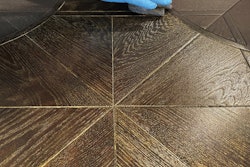
“Timeless” usually means a dark, rich color, like dark walnut on white oak, like this:
Because I understand my customer, I can usually bring a few samples instead of a full box and simplify the process, making it easier for everyone involved.
All Things Wood Floor, created by Wood Floor Business magazine, talks to interesting wood flooring pros to share knowledge, stories and tips on everything to do with wood flooring, from installation, sanding and finishing to business management.


 I’m not afraid to give the stain swatches to the customer, because they know they get to try three colors.
 It’s up to you, the expert, to use your knowledge to say yes or no to the customer when they want something that may not work in their home. This black-stained floor wouldn’t be a good choice if they keep the house hot and dry and will have gaps.
 I put down my three samples and don’t offer an opinion, and I never ask if they want to see more colors!
 I put down my three samples and don’t offer an opinion, and I never ask if they want to see more colors!
 Creating a stain sample tailored to the specific likes and taste of the customer can give them a more personal experience—for this job, my samples replicated the logo of the greatest NFL team in the NFC South (my editor disagrees with that last part).
 Buying a lightblub with adjustable Kelvin can save you major problems when creating samples.
 You have to understand how stain will look on different grades and species; these samples were done on a Brazilian cherry floor.