One month after completing a beautiful hardwood floor project, we received a call no flooring professional wants to get.
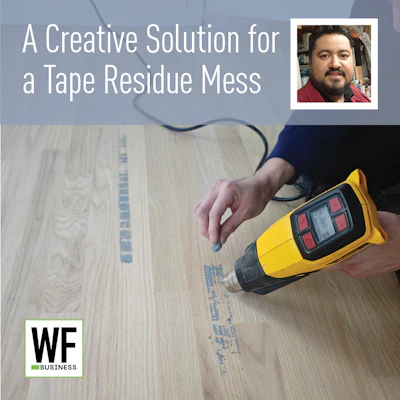
The investor had hired another crew to protect the newly finished floors during additional construction work. They used rosin paper and secured it with duct tape directly to the finished surface. When the protection was removed, the tape adhesive transferred onto the floor—leaving glue residue across large areas of the finish.
The floor looked contaminated. Resanding seemed like the only option, but we weren’t ready to accept that.
The challenge
As flooring professionals, we understand that once adhesive contaminates a cured finish, removal becomes delicate. Aggressive methods can:
- Damage the finish
- Dull the sheen
- Create uneven spots
- Force a full recoat or complete resand
We tested several common adhesive removal methods, but none gave us a safe and consistent solution.
We needed something smarter.
The breakthrough
One of our team members, Felipe, approached the problem differently. Instead of attacking the glue with chemicals or abrasives, he decided to use the adhesive itself to lift the residue. Here’s the technique that worked:
Step 1: Controlled heat application: Using a heat gun at a safe, controlled temperature, we gently warmed the adhesive. This reactivated the glue without overheating or damaging the finish.
Step 2: Creating a “glue ball”: As the adhesive softened, Felipe began forming a small ball using the glue itself—almost like rolling sticky tape.

Step 3: Adhesive lifting: Once the glue ball had enough tack, it acted like a natural adhesive remover, lifting remaining residue from the floor surface without spreading it.
Instead of smearing the glue, we were pulling it off.
The result
We avoided:
- A full resand
- A costly recoat
- Delays for the investor
- Unnecessary material waste
Most importantly, we preserved the integrity of the original finish.
This experience reinforced something we strongly believe at Cardona Flooring: Sanding and finishing isn’t just about applying products correctly, it’s about problem-solving under pressure.
Lessons for builders and investors
- Never apply duct tape directly to finished hardwood floors.
- Test protection methods in a small area before full application.
- Consult your flooring contractor before protecting new floors.
- Protection mistakes can turn into expensive repairs unless handled correctly.
Innovation happens in the field
In our industry, not every solution is found in a manual. Some are discovered on-site, through teamwork and experience. This time, a simple idea saved an entire project. And it reminded us that sometimes the best solution is not more aggressive—it’s more intelligent.