|
|

In the last issue of WFB, I wrote about “Why I Won’t Install LVP Flooring Anymore.” If you read that article (which I recommend you do before reading this), you will recall that I finished up my rant saying, “I’d much rather fade back into the bushes like Homer Simpson so I won’t come to mind for my prior clients if that LVP floor I installed for them eventually fails!”
Well, since I wrote that article exactly what I dreaded actually happened—a failure on an LVP floor I installed. I got a text message from a client whose install I completed 23 months before that text was sent. Here in California, we must stand behind our work for a minimum of 24 months (sometimes longer for other licenses).
This was the final LVP installation I ever performed … the last one. All the others are more than 24 months old now. I was almost sitting on my laurels with the last LVP article, all set to do my Homer Simpson disappearing into the bushes act.
But no, like Michael Corleone in “The Godfather Part III,” I get pulled back in while wanting to escape.
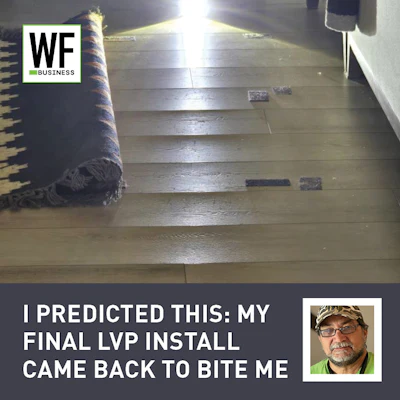
 Despite being installed exactly according to directions, 23 months after installation the LVP flooring was cupping.
So I hired my own inspector from a reputable inspection organization we all know. I am being vague on purpose (this rant is not about naming names, but rather about focusing on best practices at all times).
The inspector I retained was exemplary in integrity—I was impressed. After sending the client’s contact information and formally asking for an inspection, the lines of communication with him went dead, meaning texts and emails were being unanswered. I kinda guessed what was going on after a short while and texted him, referencing the radio silence: “Is this the way it’s supposed to be?” I finally got a response: He merely texted back, “Yep.”
This was cool. I can see where a contentious situation leading up to redress before the court could taint my defense if I was chatting up the inspector I hired. The whole process must operate on the assumption that the resulting report will be 100% beyond reproach. That’s legally like thick-plated armor. Even pieces of the LVP that had been still in the box were cupping.
Pretend this may have been you, and an inspector was able to find a tiny thing—an almost insignificant thing. So tiny it should never have presented a problem. Like I said in my last article on this topic, the whole house of cards would fall no matter how much “proof” and documentation you could give to an attorney or contractor’s license enforcement agent—no CYA process could protect you from just the right (wrong!) client and enforcement agent.
Back to my story here. I now had a certified report from a reliable organization, but I wasn’t out of the water yet. I wanted 100% closure, but I had to be patient.
After I started writing this blog post, I found out I prevailed. The manufacturer backed down and will honor their warranty (sort of)—I’m done. Done with this claim, done installing LVP, done wondering if any more old LVP installs will come back to haunt me.
I have prevailed through the heaviest part, but I don’t feel good about it, because while my clients now “won” the warranty claim, that only covers providing new product, not paying for the labor to demo the old floor and install the new one, and not paying to move the client and their furniture out of their home (this flooring was throughout their entire home).
Many of us contractors are installing LVP floors this very week, even this very day while you are reading this. All I can say to them is: Be careful, and be prepared to go through the gauntlet just as I just have.
 Other areas of the LVP installation were chipping.