Today’s market has driven increased use of engineered wood flooring for its proven ability to add tangible value to a home, sustainability, aesthetic flexibility, wide-format visuals and installation versatility. However, as design possibilities expand, we must also respect the nature of wood behavior and its inherent dimensional movement. Wood is orthotropic, meaning it moves differently across grain, along grain and through thickness. That movement plays a central role in how performance issues are interpreted.
Delamination vs. shear
I was asked to address a topic that frequently causes confusion in the field: two terms that are often used interchangeably, but incorrectly: “bond line failure” (commonly called delamination) and “shear failure” within the wood fiber itself. This discussion is intended as general education and for risk mitigation.
Understanding the distinction between these two is important when evaluating jobsite conditions, moisture exposure, acclimation variables, installation practices and warranty responsibility.
How to tell the difference
With that context, let’s focus on three practical questions:
- What does each failure mode actually look like?
- What typically causes each?
- Why does the distinction matter from a liability standpoint?
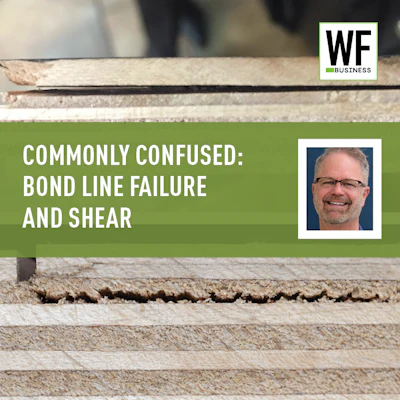
As shown in the side-by-side images at left, on the top is a bond line failure presenting as a clean adhesive separation between layers. When wood flooring is properly manufactured, this type of failure is rare. It typically indicates an adhesive or production-related issue.
On the bottom is shear. By contrast, shear occurs within the wood fiber itself. The adhesive bond remains intact, but the wood has literally pulled apart under internal stress.
What causes shear
Shear is most commonly associated with significant moisture content change after manufacturing and installation. Wood responds to environmental swings. When subfloor moisture migration, water intrusion or extreme humidity shifts occur, internal tension builds within the veneer layers. If that stress exceeds the fiber’s strength, the wood fails and “shear” happens—even though the bond line maintains its integrity.
Proper diagnosis requires more than a snapshot of current temperature, relative humidity and moisture content. A thorough evaluation considers pre-installation documentation, historical site conditions and current environmental data. Without that broader context, conclusions can be misleading.
Ultimately, distinguishing between bond line failure and shear clarifies responsibility. Accurate diagnosis protects dealers, contractors and end users by ensuring corrective action is based on cause, not assumption.
 Bond line failure (often referred to as “delamination”), shown at top, and shear, shown at bottom, are often used interchangeably but are different problems with different causes.
Manufacturing rigor is critical
A broader but related consideration is manufacturing rigor. Not all engineered wood flooring factories operate under the same internal testing protocols. For example, the ANSI-HPVA/EF 2019 three-cycle boil-soak test is a demanding evaluation of bond durability yet is not universally applied.
Likewise, not every manufacturer maintains in-house laboratory validation. When testing standards vary, that difference is not always visible on a spec sheet. In price-sensitive markets, cost can become a proxy for quality—yet adhesive systems, press cycles and quality control discipline often determine long-term performance.
Education is the best defense
For professionals in the field, education is the best defense. A working knowledge of how wood behaves coupled with an understanding of manufacturing standards strengthens both technical confidence and business protection.
In my work bridging design vision and manufacturing discipline, I see that as formats have become wider and more visually ambitious, a disciplined understanding of performance mechanics is foundational and essential for any wood floor pro dealing with engineered wood flooring.