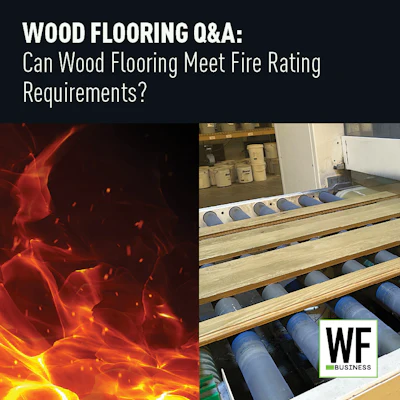
My latest commercial project specifies a Class A fire rating for all interior finishes. Can real wood flooring actually meet these strict safety standards?
Larry Holcomb, national sales manager at Reidsville, N.C.-based Premiere Finishing & Coating, answers:
This is one of the most common hurdles in commercial and high-rise design. For years, architects and specifiers assumed they had to sacrifice the warmth and beauty of natural wood to satisfy stringent fire codes. The good news is that you have both—under very specific conditions.
Class A ratings are based on ASTM E84, which measures surface burning characteristics, not full fire resistance. To qualify as Class A, the tested flooring assembly must meet limits for both flame spread and smoke developed index. That distinction matters, especially in multi-story or mixed-use buildings where additional code requirements may apply.
Raw wood on its own is combustible, but certain listed finishing systems allow wood flooring assemblies to achieve a Class A rating. Most of these systems are waterborne coatings, typically one- or two-component products used with a specified topcoat. Application requirements such as coating type, mil thickness and whether the boards must be fully encapsulated or finished only on the exposed face are manufacturer- and listing-specific.
Factory-finished products offer the most reliable path to compliance. Factory processes control coating thickness and consistency, which is critical for meeting ASTM E84 test conditions.
It’s also important to understand that Class A ratings apply only to the exact tested assembly. Changing adhesives, underlayments, substrates or coating systems in the field can void compliance—even if the flooring or finish is marketed as “Class A.” Always verify documentation from the manufacturer and confirm acceptance with the authority having jurisdiction.